

Living Worlds


There are still corners of the planet where no road has been cut, where rivers have no names on maps, and where memory is passed by story rather than machine. Anthropologists estimate between 100 and 200 uncontacted or voluntarily isolated groups remain, most in the Amazon Basin, theAndaman Islands, and the forests of Indonesia and Papua.

-
Hannah Morissey
The sands of the Thar Desert (marked in red) stretch across northwestern India and into southeastern Pakistan. In this arid expanse, the searing winds of the 'Great Indian Desert' carry the centuries-old melodies of the Langa and Manganiyar people. For centuries, these Muslim hereditary folk musicians have shaped Rajasthani folk music with their soulful cadences, enlivening the halls of their patrons across the desert villages of Barmer, Jaisalmer, and Jodhpur.

The Gurjar Girls
Living with India's wildlife in the Sariska Tiger Reserve
In the complex web of life on Earth, humans and wildlife share a relationship marked by both symbiosis and conflict. This dynamic, evolving over millennia, echoes the broader narrative of our role within the natural world. With the advent of agriculture, this relationship underwent a profound transformation. Once an integral part of the ecosystem, humanity began exerting dominion over it, reshaping the environment and our place within it

Can a community preserve its identity after 50 years of assimilation into a dominant culture? And does the longing to return to a place and the nostalgia for how life once was ever fade away? These are questions that affect all communities on the island of Cyprus, especially after the 1974 conflict. The Maronite community of Cyprus, "a religious minority," has been among
those fighting to preserve its identity.

The story of Ireland and Palestine is not one of identical suffering but of shared memory, two peoples separated by geography yet bound by the experience of occupation. Both have lived under foreign rule, both were partitioned by imperial decree, and both have seen their histories rewritten by others to justify their subjugation.
.jpg)
Written by Farhana Akter, Living With the Hills explores everyday life in Bangladesh’s hill regions, where communities navigate steep terrain, fragile ecosystems, and the quiet pressures of climate change and development. Through close observation and local voices, the article reflects on adaptation, resilience, and what it means to live in a relationship with the land that shapes both livelihood and identity.
.png)
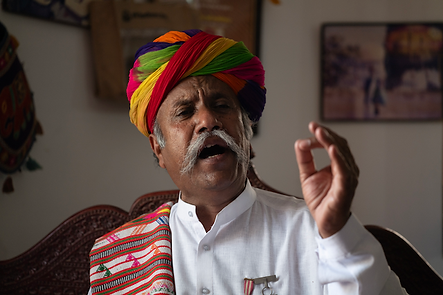
The Breath of the Thar: Anwar Khan and the Long Memory of the Manganiyars
The Breath of the Thar follows Anwar Khan and the Manganiyar musicians of Rajasthan, whose songs carry desert memory, devotion, lineage, and survival. It is a story of music not as performance, but as inheritance, held in the voice and passed across generations.

The Balti People: High Country Narrow Margins
The Balti People: High Country, Narrow Margins follows life in the mountain communities of Baltistan, where culture, faith, language, farming, and survival are shaped by altitude and isolation. It is a story of resilience in a landscape of beauty and constraint, where every field, path, and household exists close to the edge.

The Garo Record
Part One: The Man Who Came Home
The Garo Record follows the A·chik Mande of northern Bangladesh, an Indigenous matrilineal people whose land, language, farming, music, and memory remain central to cultural continuity. It is a field record of daily life, inheritance, and change, told through the people who carry it forward.