

ETHNOMAD


Article by Dr Tom Corcoran
2,000 words Published by ETHNOMAD
We were running late, and we both knew it. Heading toward the Tiger Reserve at dusk is never advisable. As the light falls, the forest changes hands. What moves then is rarely seen until it is close.
We were riding up toward Kraska village as the light began to thin, the old Royal Enfield labouring steadily over the rough track that cuts into the forest. I was travelling with Sasha, a close friend who knows Sariska as well as anyone from the outside can. The forest had gone quiet in that particular way it does as the light dims, the birds start calling, the first bat takes flight, and the air itself seems to listen.
At the edge of the reserve, Sasha slowed and pulled to a stop. He checked his phone to find a dozen missed calls. He rang the number back. Surjan answered immediately.
“Stay where you are,” he said. “There’s a tiger on the back trail. If you keep going, you will probably drive straight into it.”
So we waited. Engines off as the darkness drew in. There was no urgency in our movements, no raised voices, just a decision made with a little common sense. We would sit it out at the forest edge and see if the track cleared by morning.
This is what living with tigers actually looks like. Not the controlled encounter of a safari jeep or the curated stillness of a lodge balcony, but judgement exercised in fading light, informed by trust and local knowledge. The tiger was not a symbol or a metaphor. It was an animal moving through shared ground.
I have walked and ridden in and out of the Sariska Tiger Reserve many times. Each time, I place my trust not in signage or patrol schedules but in the people who live here. The villagers know where the tigers are, and they say little about it until they need to. What they speak less openly about are the leopards. There are far more of them, close to one hundred and seventy by current estimates, the largest concentration anywhere in India. They move closer to the village, and they are harder to read.

Throughout the day, the girls gather water for daily needs, while the men make longer journeys to a distant well for drinking and cooking water. The work is demanding and often exhausting. There is nothing romantic about being a community; it requires shared commitment, cooperation, and effort.
For most of human history, people did not stand apart from nature; they moved within it, constrained by its limits, attentive to its warnings. The rupture occurred gradually, with agriculture, enclosure, and, eventually, industrial modernity. Reciprocity gave way to dominion, and extraction learned to call itself progress. Today, the imbalance is unmistakable. Wild mammals now constitute only a small fraction of the total mammal population on Earth, whereas humans and the animals we domesticate dominate almost entirely. Conservation has become a race to slow a loss that accelerates everywhere.
India’s own story mirrors this global arc. During the colonial period, wildlife was depleted with ruthless efficiency. Tigers were shot for sport, skins, and status. After independence, pressures continued through poaching, habitat loss, and the expansion of infrastructure. When Indira Gandhi launched Project Tiger in 1973, it marked a turning point. The programme worked, and tigers returned to landscapes from which they had nearly vanished.
But recovery brings its own complications. Large predators require space, prey, territory, and quiet. When they return, and numbers increase, they do not recognise boundaries drawn on maps. They move through lived landscapes, into the routines of people who never left.
Sariska covers roughly eight hundred and sixty-six square kilometres of dry deciduous forest in Rajasthan’s Aravalli range. It houses tigers, leopards, striped hyenas, wild boar, crocodiles, and more than two hundred bird species. It also holds villages. Nearly two hundred lie on the periphery of the reserve, with only a few remaining inside following successive relocation programmes. Conservation here did not begin with absence; it began with hard negotiation.
Among those who remained are the Gurjar, pastoralists whose lives are shaped by movement, livestock, and an intimate reading of the forest. They do not speak of wilderness. They speak of paths, water points, shade, danger, and timing. Their buffalo graze the grasslands that sustain herbivores, which in turn sustain predators. Their daily routines open and close spaces within the forest. Knowledge here is situational rather than theoretical, learned early and reinforced by consequence.

The Gurjar girls prepare for the afternoon in the treetops, carrying a small axe and a bamboo pole. They move deliberately, selecting trees often more than a hundred metres apart and staying in contact through soft whistles and calls. The work connects them, their buffalo, and the trees in a relationship that sustains them all.
Coexistence is not romantic; it is managed. Tigers and leopards move mostly at night. People withdraw then, retreating to their huts. At dawn, the forest shifts again. Humans emerge, sometimes catching the fading trace of a predator’s passage. Livestock losses occur, but they remain surprisingly rare. When they happen, they are absorbed into a broader understanding that living alongside animals larger and stronger than oneself carries risk.
Children grow up with this knowledge. It is not taught in classrooms; it is absorbed through watching, listening, and remembering.
Each morning, as the light strengthens, the girls head into the forest. Their paths are narrow but unmistakable, worn by generations of feet. They climb trees with a confidence that comes only from familiarity. They gather what is needed and leave the rest. Fear does not guide their movements. Attention does. Tigers move through the same forest, and so do leopards, hyenas, and wild boar. They skirt the lake where crocodiles bask. The girls know where animals are likely to pass and when. Despite all my years in wild places, my questions about living with such predators carry the tone of a child’s curiosity, and I sense they recognise it as such.
Watching the girls move through the trees, jumping lightly from limb to limb, it is impossible not to think about what the Gurjar stand to lose beyond land itself. If they are pushed toward urban life, there is no replacement ground waiting for their buffalo, no open space where their way of living can simply be transplanted. What disappears is not only pasture or livelihood, but a body of knowledge carried in movement, timing, and attention. These skills are barely recognised, let alone documented or understood, and they do not survive relocation easily. In cities, the forest does not train the senses. It dulls them. Noise replaces listening. Crowds erase distance. The attentiveness that Sariska demands is slowly overwritten.
Prim Gujar, high in the treetops of Sariska, cutting fodder leaves for her family’s buffalo. What might look like damage is in fact a form of careful coppicing, guided by generations of Gurjar knowledge. When practised with restraint and timing, this practice stimulates new growth, keeps trees healthy, and sustains both forests and livestock. It is not exploitation. It is management, learned by watching the forest closely, year after year.

There is a term for this, used by conservation scholars: the extinction of experience. It describes what happens when everyday contact with the natural world falls away, not all at once, but gradually, through distance and substitution. What disappears is not knowledge in the abstract, but a way of noticing. Silence loses meaning. Movement goes unread, and attention drifts.
Among the Gurjar, awareness is not taught; it is earned through repetition and consequence. Children learn by moving through a world where listening matters and mistakes carry weight. Yet conservation rarely pauses to ask how such understanding is formed, or what is lost when it is no longer needed. We have become adept at counting animals and mapping corridors, but we struggle to recognise the quiet human skills that make coexistence possible. This is not an oversight. It reflects a conservation mindset more comfortable measuring wildlife than learning from those who have lived alongside it.
It became clear just how connected to the forest these children are one morning when we planned to take a group of older children on a field trip to Jaipur. Some of them had never left the park. None had ever experienced a city.
We gathered early at the school in Kraska. A small group of children, two teachers, Sasha and I. The light was still soft. The forest had not yet fully shifted into day. We had a long walk ahead, two to three hours on foot, descending from the plateau to reach the edge of the reserve where transport could meet us.
Before we set off, one of the community leaders pulled Sasha and I aside. “When you are walking out through the forest, watch the children,” he said. Sasha smiled. “Don’t worry, Pandit-ji. We will watch over them. They will be fine”
The elder looked directly at Sasha. “I am not worried about the children. It is you two who need to watch them. Follow them. If they react to something, do exactly as they say.”
Only then did it settle. This was their environment, not ours. The children were not being protected. They were the ones with the knowledge and the instinct.
Later, in the traffic, smog, and noise of Jaipur, the inversion became complete. In the forest, the children were guides. In the city, they became novices overnight. The skills that kept them safe among predators were suddenly invisible, unrecognised, and unnecessary.
A close-knit group of Gurjar girls on a field trip beyond the Sariska Tiger Reserve, the first time outside the forest for some of them. Curious and excited, they also face a sensory overload very different from the attentiveness required at home.

When we returned to the village a few days later, life slipped back into its familiar rhythm. Smoke rose from cooking fires and drifted through the morning mist. The girls moved easily between tasks, tending buffalo and dogs that are part of the household rather than livestock set apart. Breakfast was shared around the fire: chapati and dhal, eaten with your hands as food was passed from one person to the next. Stories from Jaipur surfaced quietly. The size of the roads, the railway, the noise, the smell, the crowds. They spoke with curiosity and enthusiasm, but left no doubt they were happy to be back home and back at their little school.
Formal education arrived late in Sariska, only after sustained community effort. The small village school, supported by Bodh Shiksha Samiti, has altered daily routines and expectations, especially for girls. Teachers are held in high regard, not simply as instructors but as people who have learned to move between worlds. For some of the girls, becoming a teacher is now imaginable in a way it never was before.
But the school ends at grade five. Beyond that, education requires leaving the reserve.
This is where agreement gives way to deliberation. The question of whether girls should continue their education outside the forest is discussed openly, often at length, in formal meetings and informal conversations. These are not abstract debates. They are careful, sometimes tense, assessments of risk, trust, and consequence. Parents weigh opportunity against separation. Fathers and mothers speak about safety, reputation, and distance. Elders ask what is gained, and what may not return.
Sasha has sat through many of these meetings as part of the education programme. Affordable boarding options in Jaipur exist, and they have made continuation possible in theory. In practice, the decision is never simple. Sending a daughter away means more than paying fees. It means accepting that daily oversight will be replaced by trust. Those skills learned in the forest may become less relevant. That a child may come back changed in ways that are difficult to name. And, who will feed and water the buffalo?
The concerns are not only cultural. Families speak about health, about children who left and returned disconnected, less grounded in their spirits. They worry about girls learning to navigate a world that does not recognise the knowledge they already carry. At the same time, they recognise that without formal education, the next generation will have little voice in decisions that increasingly shape their lives.
Education here is not rejected. It is argued over, revisited, and held up against lived experience. The question is not whether learning matters, but how to ensure that gaining one kind of knowledge does not require surrendering another.
For now, the balance remains uneasy. Some girls will leave, and some will stay. The community recognises there is no perfect answer yet, only choices made carefully, together, and with full awareness of what each path might entail. They also consider how these decisions affect their ability to retain their land and their way of life.
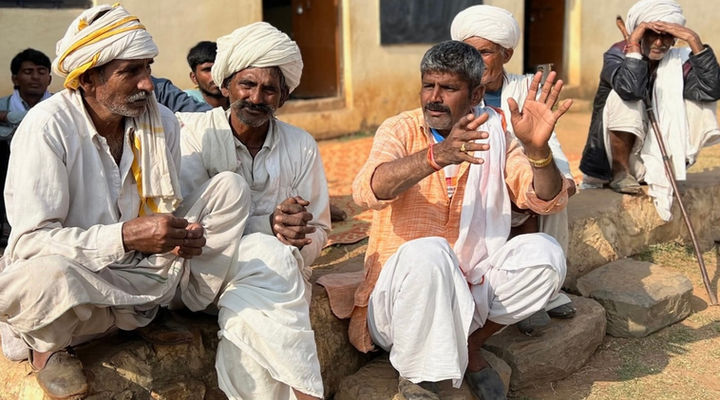
Gurjar elders in Sariska reflect on a future shaped by conservation policies they did not design, holding their ground as the space for tribal life inside the reserve steadily narrows.
It is in this context that authority inside the reserve becomes visible.
The authorities are well aware of the pressure higher education puts on the community, just another of the many friction points between the Gurjar and the outside world.
Park managers are literally the gatekeepers, and patrols pass regularly around the village. There is even a ranger hut now positioned within binocular view. Everyone entering or leaving in a vehicle is logged at the outside gate. The Gurjar speak about this matter-of-factly, saying that most of their movement is through the back trails, through the forest, across the ridge, on foot or by motorcycle. Not to hide, they insist, but because life here does require them to move fast, to travel at speed on the bumpy mountain road by 4WD. The Rangers rarely leave their vehicles, and the forest they oversee is often experienced through dirty windshields and long reports.
The Gurjar know that conservation is never neutral, and taking their own trails ensures separation from the conservation authorities, but it also signals to the authorities that their lives are not fully controlled.
But the central question the Gurjar leaders pose is: how many tigers are enough? Even the Gurjar know that the balance may, at some point, skew; a drought or a fire may dramatically reduce the tigers' prey, and, in turn, their buffalo may be at risk.
In conversations with guides and drivers beyond the reserve boundary, the logic is expressed plainly. More tigers mean more tourists. More tourists mean more revenue. Numbers become targets rather than thresholds. The forest becomes a balance sheet, its success measured upward without regard to saturation or consequence.
The Gurjar notice this, and they also notice something else. When they are not present, watching the forest as they always have, poaching returns. No accusations are made directly. But the implication is shared quietly and consistently. Those with the greatest access and authority are often the least visible on the ground.
In truth, we should be as intent on understanding the Gurjar and other communities with long, shared histories of living in landscapes as we are on studying wildlife. We know remarkably little about our own ways of being in the world, yet we speak with confidence as experts on other species.
What remains largely unexamined is how children here develop such precise awareness of the forest in the first place. How they read signs others miss. How they sense shifts in animal behaviour before danger appears. Conservation has invested enormous effort in counting animals and mapping corridors, yet almost none in understanding how people have lived so completely with wildlife as part of an ecosystem.
That failure is not academic. It shapes policy, displacement, and whose knowledge is allowed to matter.
As evening settles, Sariska reorganises itself. Predators move, and the Village quietens. Fires glow low, and the Buffalo settle. Stories are told, not as entertainment but as instruction. They carry memory, caution, humour, and belonging. This is not harmony. It is a constant negotiation; it's work; it's maintaining a life of purpose, and it is the search for balance.
The return of the tiger to India is a genuine triumph. Whether that success can be balanced with the lives of those who have always shared its landscape remains unresolved.

Prim Gurjar sits by her fire in quiet reflection, much as her ancestors did. At her young age, she has known only the rhythms of the forest and the seasons, without electricity or constant interruption. She may be among the last of her tribe to experience life in this way.
