

Living with the Hills
"How Environmental Change Is Reshaping Culture in Bandarban"
ETHNOMAD

Written by Farhana Akter
Photography by Thowai Sing Nu Marma
1,500 Words Published by ETHNOMAD,
January 2026
Bandarban, one of Bangladesh’s hill tract regions, greets visitors with cool breezes and layered green hills that offer a rare sense of calm. For many people living in cities, this landscape represents an escape and a place of rest. For the Indigenous communities who call these hills home, it is something far more fundamental. The land itself shapes their lives, livelihoods, and traditions. As the climate changes and the environment becomes less predictable, these communities are among the first to feel the consequences.
During a field visit to a remote village in Chimbuk, elders spoke of how life once moved to a different rhythm. In the past, the scent of ripe sticky rice from the jhum fields was so strong that even travellers passing along the main road could smell it. After meals, families rested in their machang houses while the breeze carried the same aroma through the hills. Their traditional songs also speak of their entwined bond with the land and agricultural cycle. Among the communities celebrating the peak harvest are the Chakma, the region's largest indigenous group, and the Marma, the second-largest, both of whom have unique songs dedicated to the Jhum cultivation. During peak harvesting season, Marma youth used to gather at the jhum ghor to sing their traditional song, Kapya, while the Chakma shared evenings performing the ballad Genkhuli Pala. These songs were once woven into daily life. Today, they are rarely heard. The fading of music reflects deeper changes taking place across the hills.
Jhum Cultivation
As traditional songs fall quiet, so too does the rhythm of jhum cultivation, the foundation of Indigenous life in Bandarban. Jhum is a rotational farming system in which rice is grown alongside sesame, cotton, chilli, and other crops. After one cycle, the land is left fallow for around five years, a period known locally as rainna. During this time, farmers move to another plot, allowing the soil to recover naturally. Secondary crops often emerge spontaneously, providing food diversity while restoring fertility without chemical inputs.
For generations, jhum followed environmental cues that farmers understood intimately. Elders knew when to clear the slopes and when to let the hills rest. They read the sky through cloud movement, shifts in wind, and the smell of soil after the first rains. Jhum was never just agriculture. It was memory, patience, and trust built through long observation of the land.
In recent years, these signals have become increasingly difficult to interpret. Prolonged heat dries the soil and weakens crops, whereas intense rainfall increases the risk of flash floods and landslides, often destroying fields that took weeks to prepare. Farmers describe planting seasons that no longer arrive when expected and harvests that can no longer be relied upon.
.jpg)
A small field hut overlooks jhum plots in the Chittagong Hill Tracts. Built to support rotational farming rather than permanent settlement, such shelters mark a way of working the land guided by patience and long observation. As climate patterns shift and fallow cycles shorten, the agricultural rhythm these structures once served grows increasingly difficult to sustain.
External pressure
Beyond the shifting climate, heavy external pressures have also forced indigenous communities away from their ancestral ways, into a desperate struggle for survival. Resettlement projects under various government-sponsored programs occupied vast areas of forest and agricultural land, once used by indigenous communities. As the population grew and land shrank, pressure mounted on Indigenous families who depend on the hills.
Moreover, the state force presence in the hill tracts is much higher. Reports suggest that in some high-conflict areas, there is one soldier deployed for six civilians, requiring significant land for camps and access roads. Some areas are also occupied by interest groups for reserved or state forests, which are largely used for commercial monoculture, such as rubber, teak, and acacia.
Farmers now can no longer afford to shift from one hillside to another and allow enough time for fallow and soil recovery. What is often described as unsustainable practice today is, in reality, the collapse of the conditions that once made jhum sustainable. Forced to shorten fallow periods, they now rely on chemical fertilisers and pesticides to extract yields from exhausted soil, a challenge the previous generation rarely faced.
Hillsides that once supported many crops for household consumption now grow only a few, such as cucumber, bottle gourd, and sweet pumpkin, primarily for market sale. As fields lose diversity, so too does the knowledge of mixed cropping, seed preservation, and seasonal cycles that sustained these communities for generations.
.jpg)
A man and child look out from a small window of a bamboo house in the hills. As land access tightens and outside pressures reshape daily life, homes like these increasingly sit at the intersection of continuity and uncertainty, where decisions made far beyond the village edge begin to press inward.
Indigenous Food Habits
Another evident sign of change appears at the dinner table. For generations, Indigenous families relied on forests, streams, and jhum fields for daily food. Wild vegetables, spices, and herbs were gathered from surrounding hills, while fish were caught from local streams and the Sangu River. These foods provided nutrition, shaped seasonal rituals, and connected daily life to the landscape.
When I first visited Bandarban in 2016, local markets were filled with wild vegetables rarely seen in the lowlands. Over time, this variety has declined. Market stalls now carry fewer traditional foods and a more uniform supply. Residents explain that wild spices, amaranth, and stream fish have become increasingly scarce.
These changes reflect broader transformations in land use. As jhum fields give way to monoculture and forests are cleared, foods that once came directly from the hills are disappearing from everyday life. The market, once a mirror of ecological diversity, now reveals how deeply farming, food, and culture are being reshaped.
Culture and Craft
The same forest resources that sustained food systems also shaped cultural life. Rituals, music, and craft traditions grew from what the hills provided. Among the Mro community, the traditional flute known as the Plung is played during cultural events and ceremonies. Made from bamboo pipes and forest gourds, the instrument depends on materials that once grew easily in shaded, stable soil.
As forest conditions deteriorate, these materials have become harder to find. Thin bamboo and delicate gourds struggle to grow as hillsides heat and erode. Each year, fewer flutes are made, and village gatherings grow quieter. A similar silence is settling around the weaving loom. For generations, Mro women collected wild cotton from the forest, spinning it into thread and weaving garments worn within the community. As forest cover retreats, wild cotton has become scarce and expensive. Cotton that was once freely gathered must now be purchased at prices beyond the reach of many households. As a result, weaving has slowed, and traditional clothing is increasingly replaced by factory-made garments from the city.
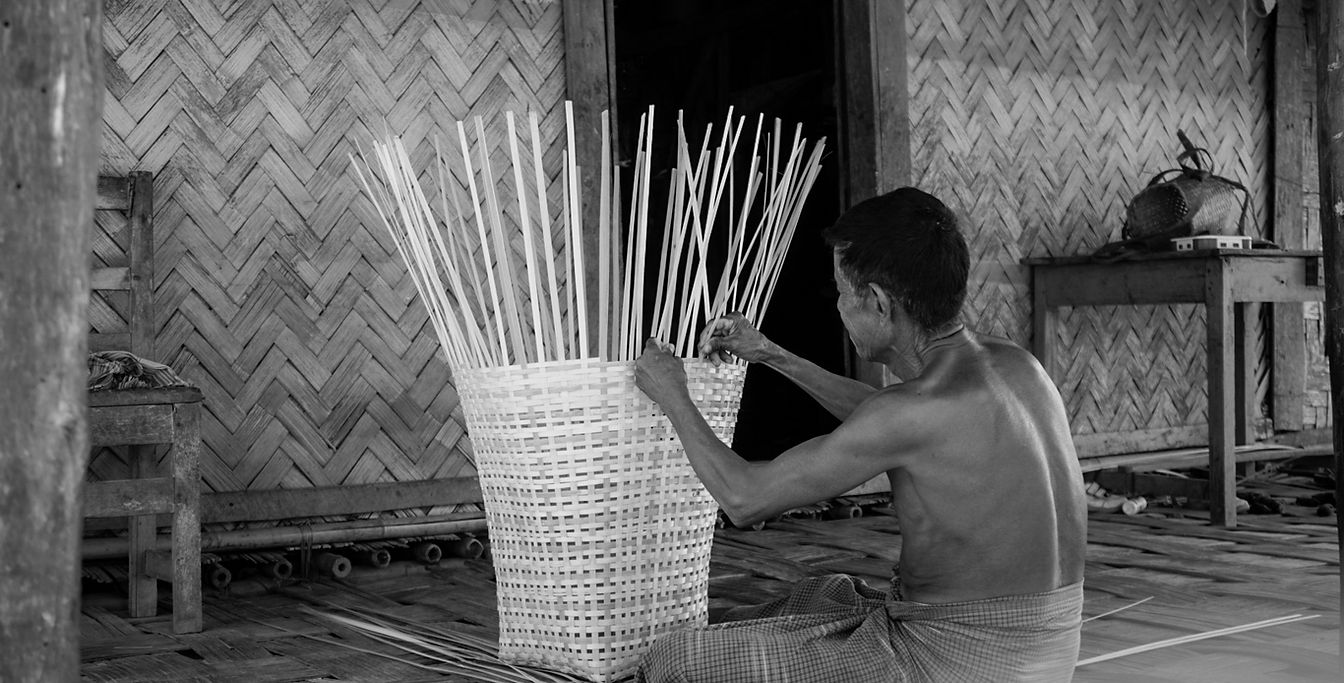
Even everyday tools are disappearing. The thrung, a woven bamboo basket used to carry harvests, requires a specific flexible bamboo that grows only in deep, undisturbed forest shade. As these areas are cleared for commercial crops, the materials vanish. Without the right bamboo, the basket cannot be made, and a practical element of daily life quietly disappears.
.jpg)
A basket maker works bamboo strips by hand, drawing on techniques refined over generations. In the hill regions, craft is not decoration but infrastructure, supplying everyday tools while carrying knowledge about materials, rhythm, and use that remains largely invisible to formal economies.
Architecture
Bamboo also plays a central role in traditional architecture. Indigenous communities in the hill tracts have long lived in machang houses, stilted structures constructed from bamboo and grass on sloping terrain. To visitors, these may appear simple. In reality, they reflect generations of environmental knowledge.
Raised several feet above the ground, machang houses protect residents from flash floods and wildlife while allowing water to pass beneath during heavy rain. Their lightweight structure reduces pressure on fragile hillsides and will enable families to relocate as jhum cultivation shifts from one area to another.
Today, this cycle is breaking. Bamboo and grass have become scarcer and more expensive. As farming moves toward monoculture and permanent settlement, families increasingly build houses from mud and concrete. While these structures appear stronger, they are heavy and inflexible. On steep, rain-soaked slopes, they compress soil and increase the risk of landslides. In recent years, landslide-related injuries and deaths have risen sharply across the hill tracts.
Bringing Heritage Stories to Life
.jpg)
A traditional machang, a raised bamboo home common in the hill regions of Bangladesh, reflects a way of life shaped by terrain, climate, and generational knowledge. Built to adapt to steep slopes, monsoon rains, and forest living, such structures now stand at the edge of a cultural emergency, as land pressure, modern materials, and development policies steadily erode the knowledge that sustained them.
A Cultural Emergency
The crisis unfolding in Bandarban shows that climate change is not only an environmental or economic issue. It is a cultural emergency. As Indigenous communities are pushed toward market-driven survival strategies, they are forced to abandon systems that once balanced food security, ecology, and identity.
The rise of mass tourism has added a new layer to this emergency. Travellers come to these hills seeking a connection to nature and a glimpse into a unique indigenous way of life. Yet, the very industry that markets this "purity" is responsible for its destruction.
High-end resorts and "eco-cottages" are often built by clearing the same forests and occupying the same hilltops that indigenous communities once protected. Instead of supporting the local economy, much of the profit flows to outside interest groups, leaving indigenous people as "props" for photos rather than stakeholders in their own land.
What is being lost is not only songs, houses, and tools, but also a tested way of life on fragile hills. If these systems disappear, the loss will not be symbolic. It will be practical, measurable, and challenging to reverse. The future of the hills depends not only on protecting the land but also on sustaining the knowledge that has long enabled people to live with it.
.jpg)