top of page
ETHNOMAD

Fading Cultures Magazine

Instagram Post V1 2024-2 copy 2_edited.p

ETHNOMAD is a field-based cultural research organisation producing long-term ethnographic documentation of living cultures under pressure, published through Fading Cultures Magazine for preservation, education, and institutional memory.

  • People, Nature, and Consequence
  • Living Cultures Under Pressure

  • Conservation Ethnography 
Latest Digital Magazine Out Monday.jpeg
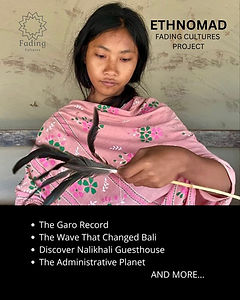
Thowai Sing Nu Marma(22).jpg

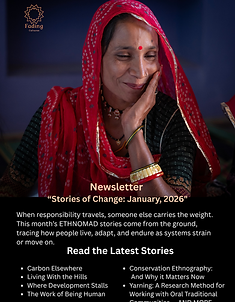
STORIES OF CHANGE

Carbon Elsewhere is an essay on climate responsibility, conservation, and the quiet ways its costs are displaced. Drawing on years of fieldwork from Madagascar to East Africa, the article examines how carbon offsetting, fortress conservation, and climate finance reshape land, livelihoods, and power, asking who truly bears the burden when responsibility travels further than emissions.

Written by Farhana Akter, Living With the Hills explores everyday life in Bangladesh’s hill regions, where communities navigate steep terrain, fragile ecosystems, and the quiet pressures of climate change and development. Through close observation and local voices, the article reflects on adaptation, resilience, and what it means to live in a relationship with the land that shapes both livelihood and identity.

Screenshot 2025-12-20 at 08.16.08.png
The_Work_of_Staying_Human 2Artist Name
00:00 / 18:10
Humanitarian-2.jpeg

IN FOCUS

The Work of Staying Human reflects on what humanitarian action is and what it was never meant to be. It is not a solution to war, displacement, or political failure. It is the work of easing suffering, protecting dignity, and remaining present when systems falter. Drawing on lived experience from Afghanistan, Lebanon, Nigeria, and Bangladesh, this piece examines how humanitarians continue to hold the line as crises become permanent, budgets shrink, and responsibility remains.

Written by Dr Tom Corcoran, this essay traces life in self-built neighbourhoods from Karachi to Dhaka through the lens of friction rather than poverty. Drawing on long-term fieldwork, it examines how effort accumulates or resets, how traditional knowledge sustains continuity, and why development often stalls when it fails to recognise where daily life actually slows, strains, and holds together.

Friction Where Development Stalls.png
Yarning Article Updated.png
Ethnographic Guide Part Three ETHNOMAD.png

Part 3 Out February 2026

Discover Conservation Ethnography?


Conservation ethnography examines how conservation reshapes human lives, knowledge, and relationships with land. It does not oppose protection, but questions models that treat people as secondary to nature. Grounded in long-term fieldwork and listening, it understands landscapes as lived places shaped by memory, labour, belief, and restraint. It asks who decides what protection looks like, whose knowledge counts, and what is lost when land becomes a system rather than a home.

Ethnography Overview ETHNOMAD.png
ETHNOMAD Ethnography Field Guide Part Two Oct 2025.png

"Ethnographic field guides for understanding places as lived realities, not project sites."

The Nature of Things

News: Climate Change

Humanitarian-2 3.jpeg

By the end of 2025, climate change was no longer framed as a future risk. It had become a daily condition shaping how people live, work, and move across landscapes.  Global temperatures hovered around the 1.5°C threshold, not as an abstract benchmark but as lived experience. Prolonged heatwaves across South Asia and ... Read the full update

People: Continuum People

1.jpeg

World Within Worlds: Continuum People and the Fragile Journey of Freedom explores Indonesia’s last uncontacted forest tribes, their resistance to modern intrusion, and the delicate balance between survival and isolation. A powerful reflection on what freedom means when the world presses in an ETHNOMAD feature on humanity’s last frontiers of autonomy.

 PROJECT UPDATES

Food: The Aging Harvest
The Aging Harvest.jpg

Explore what happens when farming knowledge outlives the people who carry it. Set against rural landscapes shaped by generations of labour, the article examines ageing farmers, departing youth, and the quiet erosion of seasonal knowledge once passed hand to hand. It asks what is lost when food systems survive but the cultural memory behind them does not, and why sustaining agriculture without sustaining people is a fragile form of progress.

5 3.jpeg
_Y6A2267.jpeg
Latest Digital Magazine Out Monday.jpeg
A River Transect:
People, Culture, and Climate from the Himalayas to the Bay of Bengal
Shared Ground: Elephants, People, and Movement in Bangladesh

BRINGING HERITAGE STORIES

TO LIFE THROUGH THE PEOPLE

WHO LIVE THEM

Screenshot 2026-01-03 at 22.09.46.png

What to watch

“Sangrai” is the water festival celebrated by the Marma communities in the Chittagong Hill Tracts, Bangladesh. This fascinating journey takes deep into the colourful history, enchanting myths, and lively celebrations that make Sangrai so special. With roots tracing back through generations, Sangrai serves as a symbolic marker of the transition into the new agricultural year; originating as a humble observance of the agricultural cycle, Sangrai has undergone significant evolution over the years, shaped by socio-economic changes, religious influences, and the passage of time. 

L1000694.jpg
  • LinkedIn
  • Youtube
  • Instagram
  • Facebook
2.jpg
Title Page.jpg

Support Our Mission

  • Become a sponsor of the Fading Cultures project.

  • Support our magazine, films, expeditions, events, workshops and training courses.

  • Help us continue the cycle of conservation, restoration and documentation.

Contact

info@fadingcultures.org 

Nat Geo Logo
EXPED Sponsor Logo
Refugee Aid Logo
UCC Logo
Award
Conservation Livelihoods Int Logo
Rohingya Logo
Birmingham Logo
Sumatra Logo
UCD Logo
Pariaman Tourism Logo
Tourism Pariaman Logo
LA Indonesia Padang
bottom of page