

What the Fire Carries
"Living heritage and the architecture of survival."
By Dr Tom Corcoran,
Published by ETHNOMAD 2026


The turpentine trees (Syncarpia glomulifera) in the Watagan Mountains rise straight and patient, their bark dark and fibrous, their trunks releasing the faint scent of resin after rain. As a boy growing up in New South Wales, I walked beneath them thinking they were simply part of the bush, tall, silent, permanent. The ridgelines above the Hunter Valley felt empty, as landscapes often do to those who do not yet know how to read them.
It has taken decades and distance to understand that nothing about that country was empty.
Turpentine thrives in poor soil. It endures fire. Its timber was once prized for wharves and bridges because it resists rot and marine borers. It survives where other species struggle. When I return now, after more than twenty-five years living and working beyond Australia, I see those forests differently. The hills feel layered. The silence feels inhabited.
As a child, I did not know whose country I was walking through. I did not hear the Worimi, Darkinjung or Awabakal language in classrooms. I did not understand that the fire scars along the slopes were once deliberate, patterned, seasonal, part of a knowledge system refined over tens of thousands of years. I was growing up inside the making of a modern Australia, confident and Anglo-framed, reshaping itself into a multicultural nation while quietly excluding the sovereignty of its first custodians.
My own Irish family was part of that construction. We arrived under the Ten Pound Fare Assistance Scheme, categorised as “New Australians,” and encouraged to integrate into a national story still overwhelmingly white and British in tone. In Australian pubs and kitchens, Irish intangible cultural heritage was expressed through songs, poems, religious rituals, costumes, food, and drink. A people distant from a home, with a deep Nostalgia, that comes from the words, nostos, meaning homecoming, and algia, meaning pain. Longing for that familiarity stitched identity across oceans. It allowed us to retain a sense of belonging while becoming the New Australian.
That nostalgia was accommodated. Indigenous law was not.

Feet strike red earth in rhythm, sending dust into the late light as movement becomes memory. In many Aboriginal traditions, dance is not performance but law in motion, a way of grounding story in place and passing knowledge through the body. Each step traces ancestral journeys across country, embedding identity and responsibility into the next generation long after the dust settles.
By the time the White Australia Policy formally ended in 1966, Aboriginal and Torres Strait Islander peoples had endured generations of dispossession, disease, forced removals, mission confinement, and incarceration.
Census practices had long distorted demographic realities. Public history marginalised Indigenous experience. Cultural practices were suppressed under assimilation policies. Australia was crafting a national identity that celebrated ANZAC heroism and frontier mythology while silencing older continuities embedded in the land.
In my youth, working in Myall Lakes National Park, I began to understand what had been missing from that national narrative.
The dunes and tea-tree wetlands stretch toward the Pacific there, the water brackish, shifting between fresh and salt. It was in that landscape, at a campfire, that I first met Steve, a Worimi man who had been steadily reclaiming and reviving his Aboriginal heritage. He had begun restoring songs, sounds, stories, and dances that had been thinned by decades of disruption. Twice a week, he would turn up at the Myall Lakes eco-resort. Sometimes alone, often with a small mob, boys, young and old, cousins, and elders who sat quietly at the edge of the firelight until called upon.
As dusk settled and a fire took hold, visitors would gather. Mostly students, but at times tourists in hiking boots, families on holiday, and resort staff. School groups always shifted restlessly at first. There were no projectors, no slides, no scripts. Only flame, voice, rhythm.
In the dark around the fire, beneath the glowing stars, Steve shared a way of life.
He spoke of saltwater country and arrival stories. Of fish traps along the coast and seasonal movement inland. Of kinship law and obligations carried through generations. Of science encoded in narrative form, tides, stars, breeding cycles, plant use, and native bees. He spoke. He danced. The boys beside him followed steps that had once nearly fallen silent.
What struck me was not performance. It was a transmission.
This was history shared long before text was imagined. Knowledge carried in cadence and gesture. Memory is sustained not through the archive but through repetition. The power of oral communication was undeniable. People leaned in. Children stopped fidgeting. Even the sceptics fell quiet.
Steve was not presenting folklore for entertainment. He was reopening a system.
He was teaching heritage not only to young Aboriginal people from his community but to anyone willing to listen. In doing so, he altered a fundamental aspect of my understanding of culture. Intangible cultural heritage is not fragile because it lacks a material form. It is fragile because it depends entirely on the relationship. It exists only when it is shared, when someone speaks, and when someone listens.
What I learned at those fires travelled with me.

Three generations gather at dusk, as knowledge has always moved, face to face, voice to ear. In many Aboriginal communities, women are the quiet custodians of story, ceremony, and law, passing memory through song, touch, and ritual. What may appear as adornment is also transmission, weaving language, identity, and ancestral knowledge into the next generation long before it is ever written down.
In later years, my work took me into disaster zones, conflict zones, and displacement camps. From Burundi and Lebanon to Afghanistan, I saw intangible cultural heritage under extreme pressure. Mud and Bamboo shelters lined the hills. Tarpaulins flapped in monsoon winds. Humanitarian systems that were primarily focused on life-saving, on food, water, sanitation, shelter, and protection. Yet amid that triage, something else was being held together.
A pivotal aspect of my work as a humanitarian and ethnographer has always focused on intangible cultural heritage, whether among Burundian refugees, Malagasy or Indian tribal communities displaced by conservation efforts. And critical to this, my first task is always to understand how they view, create, and exhibit their intangible heritage, their traditions and knowledge in exile. How do they maintain ritual, song, craftsmanship, storytelling? How do we prevent humanitarian systems from negatively influencing or constraining those deep cultural expressions?
In cramped shelters, embroidery carries village patterns across borders. Wedding songs whisper so they would not fade. Recipes are always reconstructed, even if it means using unfamiliar ingredients from aid distributions. Religious practice is adapted to restricted space. In the absence of land, women become the ground upon which memory rests.
In those shelters, I heard echoes of Myall Lakes. The architecture of transmission was the same. A voice. A circle. A story. An audience.
When people are severed from land, ancestry, nature, and ritual, suffering compounds. Identity thins. Social cohesion fractures. But when cultural expression is supported, even modestly, resilience strengthens. Cultural continuity does not erase trauma. It does not rebuild houses. But it provides coherence.
Returning to New South Wales with that lens always changes what I see.
The Hunter Valley now feels more confident, more global. Vineyards are more expensive. Coal extraction cuts deeper and wider across the hills. Public recognition of Aboriginal heritage is more visible than in my childhood. Welcome to Country ceremonies open major events, from concert halls to lecture rooms. Language revival programs reintroduce Awabakal, Darkinjung and Worimi words into classrooms. Aboriginal art sits centrally in galleries that once relegated it to the margins of ethnography. Cultural burning, once dismissed as primitive, is studied as ecological intelligence in a continent increasingly defined by catastrophic fire seasons.
Progress is visible. And, so are the limits.
The 2023 referendum proposing an Indigenous Voice to Parliament revealed how fragile consensus remains when symbolic recognition approaches structural authority. The national debate exposed both expanded awareness and enduring reluctance to reconfigure power. Ceremony has entered public space as sovereignty remains contested in law.
Before European contact, more than 250 distinct Indigenous language groups existed across Australia. Today, roughly half survive in varying states of vitality. Each language encodes ecological knowledge, relational ethics, humour, and worldview. When a language declines, the loss is not merely linguistic. It is cognitive and social.
It is tempting to generalise about Indigenous conceptions of time, to describe Dreaming as timeless continuity. But Aboriginal languages vary enormously. What unites them is not uniform grammar but relational ontology. Land is not inert property. It is animate, storied, and reciprocal. Heritage in this framework is not a possession. It is an obligation.
Steve understood that instinctively. Around the fire at Myall Lakes, he was not preserving the past. He was activating the law. He was teaching that story is governance, ecology, and ethics. That history does not require paper to be authoritative.
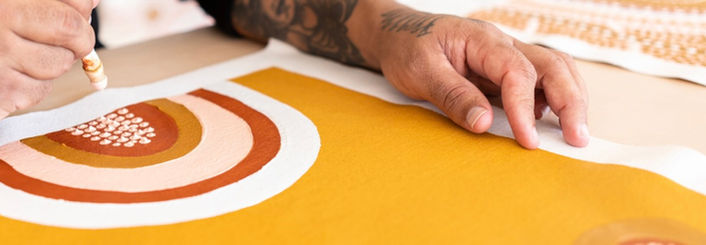
An artist’s hand moves deliberately across canvas, dot by dot, mapping country in concentric forms that mark waterholes, journeys, and ancestral tracks. What may appear to an outsider as abstraction is, in many Aboriginal traditions, a coded geography, a visual language of law and belonging. Each layer of ochre and pigment carries story and custodianship, translating land into pattern and ensuring that knowledge, once sung and walked, continues to be seen and remembered.
Art across Australia reflects the same principle. The canvases of Emily Kame Kngwarreye render desert country in fields of colour that read as abstraction to some and as precise mapping to others. Rover Thomas painted massacre sites and sacred ground in ochre tones that forced national audiences to confront suppressed histories. Albert Namatjira merged Western watercolour techniques with Arrernte perspectives, unsettling rigid cultural boundaries. Contemporary artists interrogate colonial archives, exposing fractures in the national narrative.
But perhaps no example makes the point more clearly than the Ngurrara Canvas II.
In the mid 1990s, senior artists from the Great Sandy Desert came together to paint an enormous canvas measuring over eight metres in length. It was not conceived for gallery walls. It was created as evidence for a native title claim. Each artist painted their section of country, waterholes, sandhills, songlines, and ancestral tracks. The painting functioned as a map, a testimony, an archive, and a legal argument. In court, it helped demonstrate a continuous connection to the land and contributed to a successful claim in 1997.
Years later, the canvas was taken back to Country. It was laid out on the desert ground where it had been painted first. Elders and younger community members gathered around it, sat on it, walked across it, and pointed to places embedded in pigment. What a Western museum might treat as a fragile object requiring distance was instead treated as a relational surface, something to be used, engaged with, and inhabited.
The contrast is revealing.
In many Western institutions, heritage is stabilised, climate-controlled, and frozen behind glass. Its value lies in preservation. In Aboriginal law, value lies in activation. A painting is not inert. It is country made visible. It is knowledge encoded. It is an obligation carried forward.
These works are not decorative; they are jurisdiction, memory systems, and acts of sovereignty.

Once again, on a visit to New South Wales, I am reminded of how incredible this land is, and I often think of campfires and Steve. I think of the mob beside him repeating dance steps that had nearly been lost. I think of the visitors who believed they were watching a performance, unaware they were witnessing a transmission. Then I think of Rohingya women stitching memory into cloth in exile. I think of Irish songs carried across oceans in a crowded front room.
We misunderstand what we are seeing when we reduce these moments to culture as display. When Indigenous, tribal, or traditional communities sing, dance, tell stories, carve, weave, paint, or burn country, they are not entertaining us. They are transferring memory forward. They are embedding ethics, law, ecological intelligence, kinship obligations, and cosmology into the next generation. They are ensuring continuity.
Tourism may frame it as a spectacle, and development agencies may frame it as heritage preservation. Governments may frame it as reconciliation. But for the communities themselves, it is infrastructure, and it is a critical part of their survival.
What survives in Australia will not be determined by monuments, nostalgic narratives of migration, or symbolic ceremonies alone. It will depend on whether living, spoken, and practised heritage is allowed to shape authority, land management, education, and governance.
After the rain, the turpentine releases its sharp scent again. Modern coal trains move through the valley floor beneath hills layered with ancient stories, far older than the state. The contrast is stark but not simple. The deeper question is not whether intangible cultural heritage exists. It always does; it is central to being human. The question is whether we recognise it for what it truly is.
Not simply as folklore, nor as entertainment. It is not a relic, but the architecture of continuity. It is not what we inherit passively. It is what we practice deliberately. And when it is practised, generation after generation, it does something extraordinary. It keeps people intact, creating a connection that can never be severed.

Terry Murray stands before the Ngurrara Canvas, indicating the section he painted two decades earlier, a visual record of Country and custodianship. Photograph supplied to ABC online by Monique Paschke for the Kimberley Land Council.

Conservation Ethnography places people, culture, and lived knowledge at the heart of environmental protection. It asks who speaks for land, whose knowledge shapes policy, and how conservation can work with, not against, communities. At a time of climate crisis and displacement, understanding culture is not optional. It is essential.