top of page
Screenshot 2026-03-09 at 08.35.53.png

Ethnographic Field Guide Part Two

ETHNOMAD

Understanding and Reflection
Logo.jpg

Written by​​ DR Tom Corcoran & Roel Hakemulder

PUBLISHED BY ETHNOMAD 2025​​

INTRODUCTION TO PART TWO

In Part One of this field guide, we laid the foundations of ethnography, immersive engagement, attentiveness, reflexivity, and respectful storytelling. Part Two builds on that groundwork, offering deeper insights, practical tools, and expanded awareness to help you navigate the complex ethical, cultural, and sensory landscapes of fieldwork.


Ethnography is not merely the act of observing or collecting data; it is a way of being. It demands presence, patience, and the humility to be changed by what we encounter. In this second volume, we expand your field toolkit with guidance on:

Section 1: The Responsibility of Looking

Ethics in ethnography as awareness, presence, and the moral weight of observation.


Introduction to Ethics in Practice

  • Ethics in Fieldwork: Awareness, Choice, and Consequence

  • Exploring how every decision in the field shapes both understanding and responsibility.

  • The Power of Representation in a World Always Watching

  • Reflecting on how the modern flood of images challenges truth, consent, and respect.


Case Studies

Case Study One: The Manganiyar Musicians of Jaisalmer

Representation and Responsibility

When cultural performance blurs the line between livelihood, art, and exploitation.

Case Study Two: Between Culture and Conscience – Anne’s

Dilemma in Bihar

When cultural understanding conflicts with moral duty and human

rights.

Case Study Three: The Gatekeeper – Ethics and Trust in Post-War

Bosnia

When trust, language, and power inside the team reshape what the

field reveals.


Section 2: Stories & Tools Within

What Does “Research” Really Mean?

Re-examining research as relationship, reciprocity, and responsibility rather than data extraction.

Yarning: A Supplementary Methodological Insight

Introducing Yarning as an Indigenous-informed method for ethical

dialogue.

  • Yarning with Communities: In Yarning We Hear, See, and Feel Data

  • Understanding conversation as co-created knowledge, not mere interview data.

  • Trust, Reciprocity, and Story as Method

  • Building genuine relationships that make ethical and meaningful research possible.


Section 3: Analysis: What Does the Data Say, and to Whom?

Ways of Analysing Ethnographic Data

Interpreting stories with context and care, listening beyond the words.

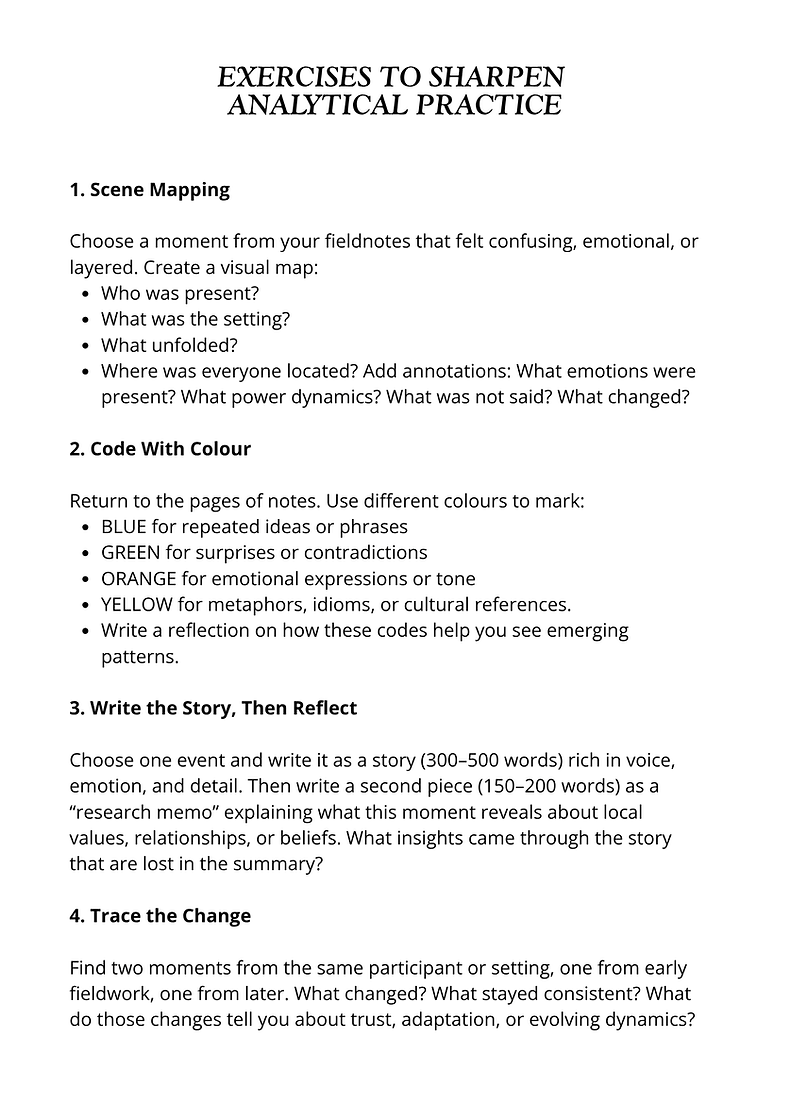
Exercises to Sharpen Analytical Practice

Practical activities for reflexive thinking and strengthening interpretive skills.


  • Field Reflexivity Activities

  • Recognising bias, emotion, and influence in one’s own field of presence.

  • Guided Writing and Thematic Mapping

  • Turning observation into a structured, ethical interpretation.


Echo and Dissonance: A Gendered Lens

Considering how gender shapes dialogue, access, and interpretation in the field.

Section 4: Community Mapping: Seeing the World Through the Lens of Those Who Live There


Community Mapping in Oral Traditional Societies

Capturing how communities visualise and share their own worlds through memory and story.


  • Working in the Field

  • Participatory approaches to mapping cultural and physical landscapes.

  • Field Checklist

  • Practical guidance for ethical and inclusive mapping sessions.

  • Community Mapping in the Digital Age

  • Integrating technology responsibly without losing community ownership of data.

  • Key Principles of Community Mapping

  • Respect, transparency, inclusion, and the right to review and consent.

  • Community Mapping Template

  • A step-by-step structure for documenting, illustrating, and archiving community maps.

  • Policies & Frameworks Ensuring Communities Are Informed

  • Guidelines and international frameworks that protect participants and uphold ethical standards.

Section 5: Ethnography Glossary

A concise reference of key concepts, terms, and ethical principles in ethnographic and participatory practice.

Screenshot 2026-03-09 at 14.12.40.png

ETHICS IN PRACTICE:

THREE ENCOUNTERS FROM THE FIELD


Three Ethical Encounters: Observing, Intervening, and Representing Ethics in Ethnographic Fieldwork rarely fall into neat categories. It unfolds in the uncertainty of real situations, moments when decisions must be made without guidance, where understanding people’s worlds collides with personal conscience, and where good intentions can have unintended consequences.

Today, this uncertainty extends beyond professional researchers. With the rise of smartphones and social media, everyone has become a documentarian. Every day, millions of people travel, photograph, and

film every corner of the globe. Yet much of this is not guided by the desire to tell others' stories with understanding or respect, but by the pursuit of likes, shares, and subscribers. Communities, rituals, and

even private lives are captured and circulated for attention rather than insight. The world’s most intimate human moments are often turned into content, stripped of context, consent, and meaning.

This new reality makes the question of ethics more urgent than ever. The power to record and share demands self-awareness and restraint. Whether behind a camera, holding a notebook, or posting online, we must ask: Whose story is this to tell? And what are the consequences of telling it?

The three case studies that follow explore different dimensions of ethical challenge. In Jaisalmer, the Manganiyar musicians raise questions about representation, livelihood, and the blurred line between participation and exploitation. In North Bihar, a researcher must decide whether cultural respect outweighs the moral duty to prevent harm. And in post-war Bosnia, a team discovers how trust and translation can be manipulated from within.

Together, these stories reveal that ethics is not a checklist but a state of awareness, an ongoing negotiation between empathy, truth, and responsibility. They remind us that the ethnographer’s role is not only to observe the world, but to consider how their presence, choices, and silence shape it.


CASE STUDY ONE: THE MANGANIYAR MUSICIANS OF JAISALMER

Each evening in Jaisalmer, a Manganiyar family brings their music to the courtyards of hotels, carrying centuries of oral tradition into the present as they sing for passing visitors. Their harmoniums, dholaks, and voices fill the warm desert air, performing songs that once belonged to royal courts and village gatherings, now sustaining family livelihoods through tourism.

To many visitors, it is a captivating scene, heritage alive, children learning the music of their ancestors beside their fathers. Yet behind the melodies lie quieter stories: the struggle to balance culture with survival, learning with labour, and tradition with change. The family depends on these nightly performances for income. The children, still of school age, perform late into the night, often too tired for morning classes. Some guests see the performance as a symbol of Rajasthan’s rich culture; others see children working when they should be studying.

For the ethnographer or photographer, such a scene raises questions that are both aesthetic and ethical. Is documenting or sharing such images a celebration of cultural continuity, or does it risk reinforcing

poverty as spectacle? Should the presence of children in traditional performances be interpreted as apprenticeship, family work, or child labour? Where does one draw the line between participation and

exploitation, authenticity and necessity?

Reflection and Discussion

  • Cultural heritage can both preserve and constrain. Economic pressures may force traditions into performance rather than practice.

  • ​Children’s participation in art and ritual is common in many societies but becomes ethically complex when linked to income generation.

  • Researchers and photographers must consider how their work represents these realities—whether it empowers or objectifies.

  • The context of livelihood, education, and dignity must inform every act of documentation.


Questions for Reflection

  • When does participation in cultural heritage become exploitation?

  • Should ethnographers intervene or observe when children are involved in economic performance?

  • How might representation, through photography, film, or writing, affect how the outside world perceives such families?

  • What responsibilities do we have when our work shapes those perceptions?​

Teaching Summary

This case highlights the ethical challenges of representing living traditions in contexts of poverty and change. It invites reflection on the blurred boundaries between art, work, and education, as well as on the

role of the ethnographer as both witness and storyteller. The Manganiyar musicians remind us that culture is not static; it survives through adaptation, often at a cost that outsiders rarely see.

7.png

CASE STUDY TWO:

BETWEEN CULTURE AND CONSCIENCE — ANNE’S DILEMMA IN BIHAR

In the early 2010s, a friend of mine, Anne, was conducting field research

on land ownership and use patterns in three villages in North Bihar, one

of the poorest and most conservative areas of India. It had been difficult

to gain the confidence of the villagers, but after several months, she

succeeded in developing relationships of trust with a good number of

families. She then became aware of preparations being made for the

marriage of a daughter in one of the households, a girl of 16.

Child marriage, defined in India as a marriage in which the female has

not completed her 18th year and/or the male his 21st, is common and

deeply embedded in local culture for economic and social reasons. As an

ethnographer trained to understand communities on their own terms,

Anne did not initially consider it her role to intervene in any way.

However, child marriage has been prohibited since 2006, and it is

considered unacceptable under the purportedly universal Rights of the

Child. Importantly for Anne, the girl was desperately unhappy about

having to marry an older man who was not sympathetic to her and

about having to leave school. Although Anne never witnessed her being

mistreated, the girl seemed to be mostly confined to the family’s shack.

After some soul-searching, which included considering that it might not

be possible to conceal her role and that she would then lose the hard-

earned trust she had gained in the village, Anne decided, about three

weeks before the planned wedding, to contact one of several NGOs in

the area working to prevent child marriage. She decided against

contacting the government Child Marriage Prohibition Officers, as she

believed that would create more trouble for the family and the girl.

NGO staff held several meetings with the girl’s parents and the girl

herself in an effort to convince the parents that it was in their and their

daughter’s best interest to cancel the marriage plans. They argued that

bearing children at her age would permanently damage her health, that

she would be a greater support to them if she finished her education,

and that she would have a happier life. The parents eventually relented,

and NGO staff accompanied them to meet the intended bridegroom to

explain the situation, emphasising the legal consequences of marrying a

minor.Anne’s role in what happened did become known, unsurprisingly, and

although the girl’s family continued to accept her as before, this was not

the case with other families. She eventually had to restart her research in

another village.

Reflection and Discussion

What can we learn from this case study?

Ethical dilemmas are rarely clear-cut. Field researchers often face

conflicts between respecting cultural practices and adhering to

universal human rights principles. There is rarely a perfect course of

action.

Balancing empathy and responsibility. Understanding a community’s

traditions does not remove the moral weight of witnessing harm.

Ethical ethnography requires reflection on when neutrality becomes

complicity.

Consequences of intervention. Even well-intentioned action can alter

relationships and trust within the community, affecting both the

researcher’s safety and the integrity of the study.

Partnership and discretion. Collaborating with local organisations can

offer a culturally sensitive path to advocacy, but such involvement

must be carefully weighed against potential repercussions.

Researcher vulnerability. Ethnographers must recognise their

position within a social web, both as observers and participants, and

prepare for the personal and professional costs of ethical decisions.

Questions for Readers:

Was Anne right to intervene, or should she have maintained her

ethnographic neutrality?

How can researchers define the limits of observation when they

witness practices that violate human rights?

What alternative actions might have protected both the girl and

Anne’s research relationships?

How should researchers prepare for ethical decision-making in

complex field situations?

Recommend to a Friend

25.png
27.png
28.png
29.png
34.png
35.png
36.png
38.png

Support Our Mission

  • Become a sponsor of the Fading Cultures project.

  • Support our magazine, films, expeditions, events, workshops and training courses.

  • Help us continue the cycle of conservation, restoration and documentation.

Contact

info@fadingcultures.org 

Nat Geo Logo
EXPED Sponsor Logo
Refugee Aid Logo
UCC Logo
Award
Conservation Livelihoods Int Logo
Rohingya Logo
Birmingham Logo
Sumatra Logo
UCD Logo
Pariaman Tourism Logo
Tourism Pariaman Logo
LA Indonesia Padang
bottom of page